

Chris Chase
Licensed Florida insurance broker · FL License #G193830 · NPN 21407586
Last reviewed October 2026
The short version
- Your home is insured for the cost to rebuild it, not its market value or your loan balance.
- Florida law requires insurers to offer replacement cost coverage and includes building-code upgrade coverage at 25% unless you reject it in writing.
- The dwelling amount is the biggest driver of your premium. Area averages by coverage amount are below.
The dwelling amount on your policy often surprises people. It isn’t what you paid for the house, and it isn’t what you owe on it.
Getting it right matters twice: it sets your premium, and it sets what you’re paid after a loss.
In this article
- Rebuild cost, not market value
- Why you can’t just pick a lower number
- Replacement cost and actual cash value
- Building code upgrades: law and ordinance
- Extra protection above the limit
- A total loss in Florida
- Your belongings
- If you can’t live there
- Things attached to the house
- What each coverage amount has cost
- Common questions
Rebuild cost, not market value
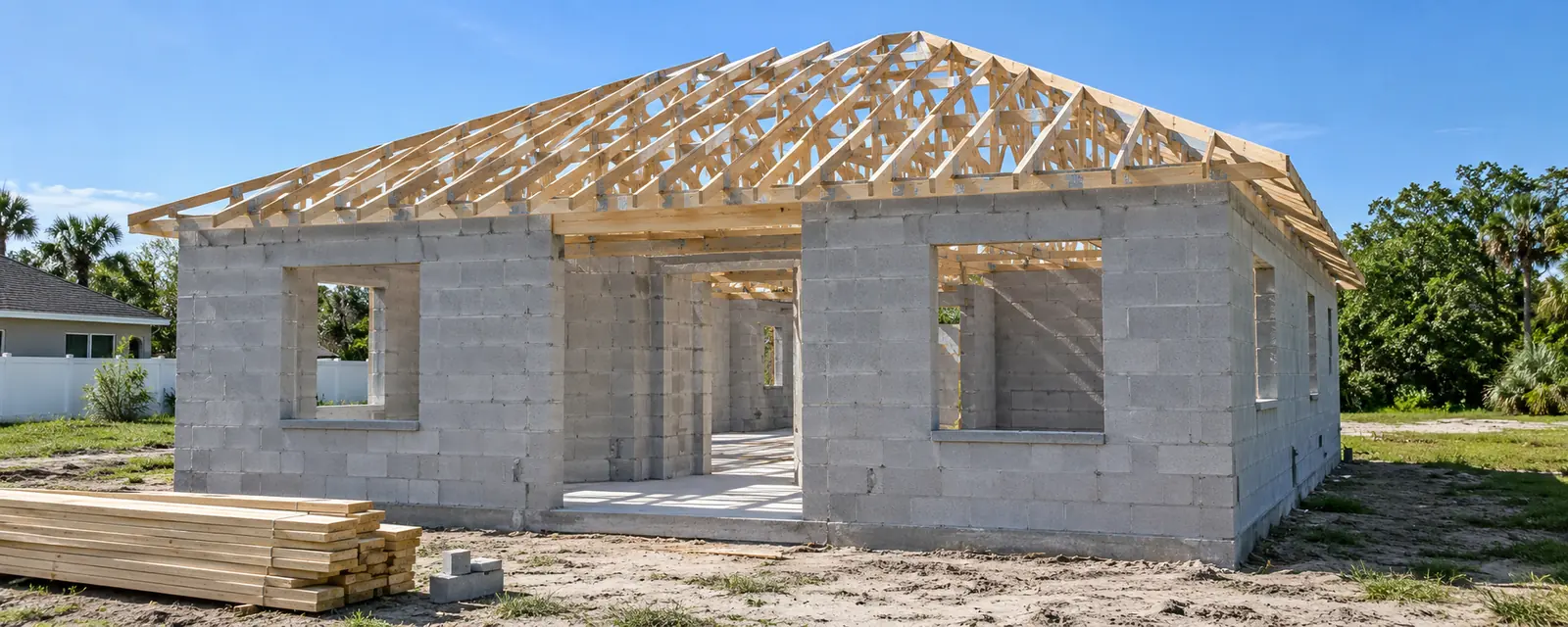
Your home is insured for the estimated cost to rebuild it: materials and labor at today’s prices. Market value includes the land and the neighborhood. So the dwelling amount can be higher or lower than what the home would sell for.
Why you can’t just pick a lower number
Insurance companies run their own rebuild estimate and expect the dwelling amount to be close to it. Most require at least 100% of the estimate, and some allow a range a little below or above it. If a home’s market value is far below its rebuild cost, some companies won’t write it.
There’s a second reason. The Florida Department of Financial Services explains that most replacement cost policies require you to carry limits equal to a certain percentage of the home’s replacement value, normally 80%. If you carry less, you can end up responsible for part of even a partial loss.

Replacement cost and actual cash value
The Department defines the two:
- Replacement cost pays the cost to replace an item, regardless of how old it is.
- Actual cash value pays what the item was worth at the time of the loss. Depreciation is deducted.
Florida Statute 627.7011 requires insurance companies to offer replacement cost coverage on the dwelling before issuing a homeowners policy. It also sets out how claims are paid: on a dwelling claim the company initially pays the actual cash value, minus your deductible, and then pays the rest as the repair work is done. On a total loss, it pays replacement cost without holding back depreciation.
Building code upgrades: law and ordinance
If your home is damaged and has to be rebuilt to current code, that can cost more than putting it back the way it was. Law and ordinance coverage pays for that difference.
Under the same statute, a homeowners policy includes law and ordinance coverage at 25% of the dwelling limit unless you reject it in writing, and you can choose 50% instead. Older homes are where this matters most, because they’re furthest from current code. Think carefully before signing it away to save on premium.
Extra protection above the limit
Some policies offer additional coverage above the dwelling limit, often an extra 25%, when the home is insured to its full rebuild estimate. Ask whether yours has it.
The Department also notes that many policies include an inflation guard that raises your limits each year, and warns that the increase isn’t guaranteed to keep up with construction costs. It recommends checking with your agent once a year.
A total loss in Florida
Florida’s valued policy law says that when a building is a total loss from a covered peril, the insurance company’s liability is the face amount of the policy. That’s one more reason the dwelling number should be accurate.
Your belongings
Contents can be covered at replacement cost or actual cash value. The difference is large on furniture, electronics, and clothes. Replacement cost on contents is optional with many companies, so check your declarations page.
Two more things from the Department of Financial Services:
- Special limits. Jewelry, guns, furs, money, cameras, art, and antiques have restricted coverage amounts and need to be added separately.
- A home inventory. Keep a list of what you own, when you bought it, and what you paid, with photos and receipts for large purchases, stored somewhere other than the house.
If you can’t live there
Additional living expenses coverage pays reasonable extra costs while the home can’t be lived in after a covered loss. It’s part of most homeowners policies. Check the limit.
Things attached to the house
- Screen enclosures and pool cages are often not covered for hurricane damage unless you add coverage, usually up to a set limit.
- Other structures. The Department notes that policies cover certain unattached structures separately from the dwelling.
What each coverage amount has cost
Averages from homeowners insurance quotes in the area over the past 36 months, shown as a yearly price:
| Dwelling coverage | Average quote (per year) | Typical range (per year) |
|---|---|---|
| Under $200,000 | $3,130 | $1,790 to $3,720 |
| $200,000 to $300,000 | $4,150 | $2,470 to $4,990 |
| $300,000 to $400,000 | $4,810 | $3,040 to $5,920 |
| $400,000 to $500,000 | $5,230 | $3,070 to $6,220 |
| $500,000 to $750,000 | $7,190 | $4,320 to $8,730 |
| $750,000 and up | $10,700 | $5,770 to $13,640 |
“Typical range” is where the middle half of quotes landed. A few very high quotes pull the averages up.
The home’s age matters as much as its size. For every $1,000 of dwelling coverage, quotes averaged about $19.50 a year for homes built before 1980 and about $6.30 for homes built in 2015 or later. These are averages of past quotes, not an offer.
Common questions
Why is my dwelling coverage higher than what I paid for the house?
Because it’s based on the cost to rebuild, which can be more than the market price, especially for older homes.
Can I insure my home for just the mortgage balance?
Generally no. Insurance companies expect the dwelling amount to be close to their rebuild estimate.
What’s law and ordinance coverage?
It pays the extra cost of rebuilding to current building codes after a covered loss. Florida law includes it at 25% of the dwelling limit unless you reject it in writing.
Rules, prices, and discounts differ from one insurance company to the next and change over time. I’ll tell you what applies to the options I find for you.
Official sources
- Florida Statute 627.7011: homeowners policies, roofs, and replacement cost
- Florida Department of Financial Services: homeowners insurance overview
Keep reading
- Why Is My Hurricane Deductible So High?
- Home Insurance Discounts and Credits Worth Asking About
- Florida Home Insurance and Roof Age
- Florida homeowners insurance
Related coverage: homeowners insurance and flood insurance.
Want a second set of eyes on your policy?
Call me or request a quote online. A real person will get back to you, not a bot.