

Chris Chase
Licensed Florida insurance broker · FL License #G193830 · NPN 21407586
Last reviewed October 2026
The short version
- Shingle roofs get scrutiny earliest, tile and metal later, and flat roofs soonest of all.
- Roof shape matters too. A hip roof often earns a wind credit.
- How the roof is insured can change with its material and age. Some policies pay less as the roof gets older.
Two roofs of the same age can be treated very differently by an insurance company. What it’s made of matters almost as much as how old it is.
This article covers the general pattern. For the legal protections that apply to older roofs, see Florida Home Insurance and Roof Age.
In this article
The general pattern
| Roof type | When companies commonly get selective | Notes |
|---|---|---|
| Shingle | Around 15 to 20 years | Some distinguish basic three-tab shingles from thicker architectural shingles and give the thicker ones longer. |
| Tile | Around 25 to 30 years | Often treated the same as metal. |
| Metal | Around 25 to 30 years, sometimes longer | Standing-seam metal is usually viewed most favorably. |
| Flat or rolled | Around 10 years | A flat roof over living space limits options the most. |
These are general ranges, not rules. Each company sets its own, they change, and some companies have no fixed age limit and go by condition instead.
Age isn’t the whole story
Florida law gives homeowners a path. Under Florida Statute 627.7011, a company can’t refuse a homeowners policy only because of age if the roof is under 15 years old. If it’s 15 or older, you can pay for an inspection, and if the inspector finds at least five years of useful life left, the company can’t refuse it for age alone.
Some companies build that into their own guidelines and will go past their usual age limit when a roofer’s inspection shows enough life remaining.
Roof shape
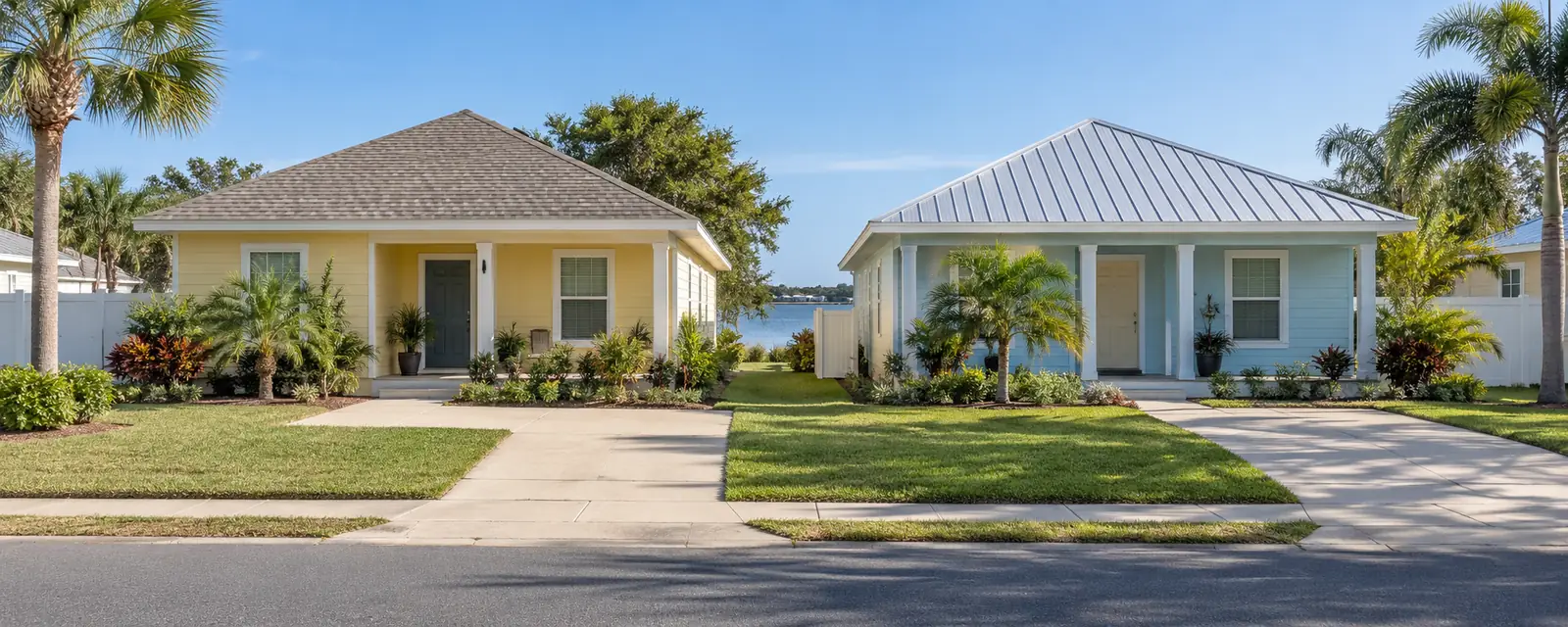
A hip roof, where every side slopes down to the walls, often earns a wind credit. Some companies will apply it from clear photos of the whole roof, without a full inspection form, as long as nearly all of the roof is hip. A gable roof, with flat triangular ends, doesn’t get that credit.
Florida Statute 627.0629 requires insurance companies to offer discounts for features that reduce wind losses, and it lists roof strength, roof covering, and roof-to-wall strength among them. See Wind Mitigation and Homeowners Insurance.
How the roof is insured
Material and age don’t only affect whether you get a policy. They can change what the policy pays.
- Replacement cost. The policy pays to replace the damaged roof.
- A payment schedule. The policy pays a percentage that drops as the roof ages. Some companies make this mandatory once a roof reaches a certain age, and the age differs by material: earlier for shingle and flat roofs, later for tile, later still for metal.
- A stated value. The roof is insured for a set amount instead of its full replacement cost, in exchange for a lower premium.
- A roof deductible. A separate deductible for roof claims, added automatically by some companies and optional with others.
On rental property policies, paying the roof at its depreciated value is common. See Insuring a Rental Property in Florida.
Layers
Installing new shingles over old ones is cheaper than a tear-off. Many insurance companies won’t accept it. If you’re re-roofing, a full tear-off keeps more companies available to you.
Flat roofs
Flat and low-slope roofs are harder to place. Some companies decline a flat roof over living space outright, some allow it only if it’s a small share of the total roof, and some will write the home only with water damage coverage limited or excluded. A flat roof over a porch or carport is usually less of an issue than one over a bedroom.
Solar panels on the roof
Panels add questions about the roof underneath. Some companies want the roof to be fairly new before they’ll accept panels on it, and some won’t accept panels on a tile roof. If you’re considering solar and your roof is getting older, sort out the roof first. See Solar Panels and Home Insurance in Florida.
Replacing your roof
- Keep the permit and the paid invoice. Without them, the roof may be rated at its old age. A closed permit is the best proof.
- Choose a full tear-off.
- Ask about the attachment. How the roof deck is nailed and how the roof connects to the walls are part of what a wind mitigation inspection records.
- Consider a secondary water barrier. It’s one of the improvements the My Safe Florida Home program lists.
- Get a new wind mitigation inspection when the job is done. Florida’s inspection form was revised effective April 1, 2026, so a new inspection should use the current version.
- Tell me. A new roof can open up companies that weren’t available before.
Choosing a material with insurance in mind
I’m not roofers, and the right material depends on your home and budget. From the insurance side, two things are worth knowing before you choose. First, a longer-lived material generally buys you more years before companies start asking for inspections. Second, whatever you choose, the documentation and the way it’s attached matter as much as the material.
Common questions
Is a metal roof cheaper to insure?
It’s usually viewed favorably and gets more years before companies ask questions. Whether it lowers your premium depends on the company and the rest of the home.
Does a tile roof last longer in an insurer’s eyes?
Generally yes. Tile is commonly given into the 25 to 30 year range, where shingle gets attention around 15 to 20.
Can I get coverage with a flat roof?
Often, but with fewer choices, and sometimes with limits on water damage coverage. Tell me how much of the roof is flat and what’s under it.
What’s in this article is general. Companies differ on the details and update them often, so I check the specifics when I quote you.
Official sources
- Florida Statute 627.7011: homeowners policies, roofs, and replacement cost
- Florida Statute 627.0629: windstorm mitigation discounts
- Citizens Property Insurance: wind mitigation form changes
- My Safe Florida Home program
Keep reading
- Florida Home Insurance and Roof Age
- Wind Mitigation and Homeowners Insurance
- Solar Panels and Home Insurance in Florida
- Florida homeowners insurance
Related coverage: homeowners insurance and flood insurance.
Ready to see what’s out there?
Tell me what you have now and I’ll compare it against the companies I work with. No pressure either way.