
Chris Chase
Licensed Florida insurance broker · FL License #G193830 · NPN 21407586
Last reviewed October 2026
The short version
- A renewal can go up because of something on your policy, something on your record, or a change in the company’s own pricing.
- Things you may not think of as “claims” can count, including injury claims where you weren’t at fault and roadside calls.
- In area quotes over the past 36 months, the same driver’s highest quote was typically about 2.2 times the lowest. Shopping is the fastest fix.
You didn’t get a ticket. You didn’t have an accident. Your renewal still went up. It’s one of the most common calls I get, and it’s a fair question.
There usually is a reason, even when nobody tells you what it is. This article walks through the ones I see most often, so you can look at your own renewal and work out which one applies.
In this article
Start with the renewal notice
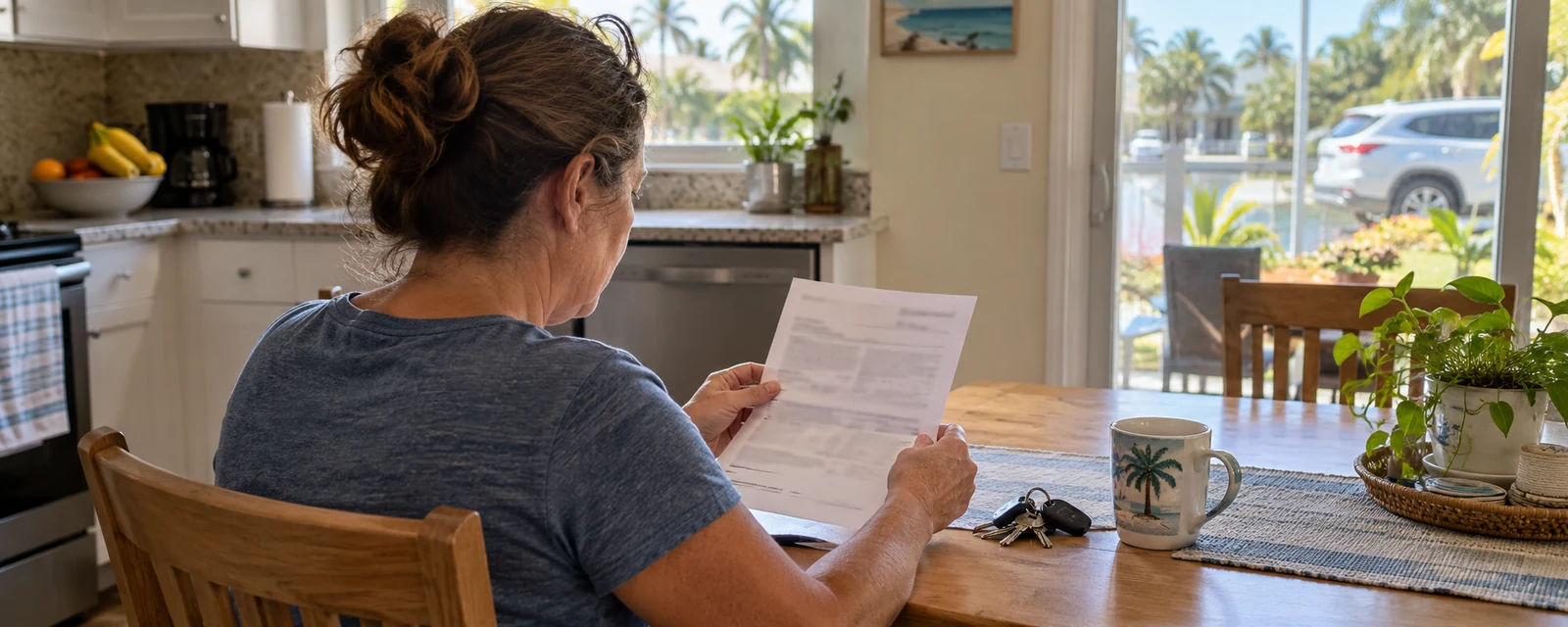
Before anything else, put this year’s declarations page next to last year’s. That page lists every driver, every vehicle, each coverage, each limit, and each discount. Most increases can be traced to a line that changed. If you can’t find last year’s, call me and I’ll go through the new one with you.
Florida gives you some time to react. The Florida Department of Financial Services says an insurance company has to give you 45 days’ notice before it nonrenews an auto policy, and has to state the reason. A renewal offer at a higher price isn’t a nonrenewal, but the same window is a good time to shop.
Something on your policy changed
- A discount dropped off. Some discounts depend on paperwork, like proof of your prior insurance. If the proof arrives late, the discount can be reduced or removed.
- A driver was added or aged into a new bracket. A teen who gets licensed changes the price. So does a young driver’s birthday, in either direction.
- A vehicle changed. A newer or more valuable vehicle costs more to insure, and adding collision and comprehensive raises the price.
- Your address changed. Where the car is kept overnight is part of the price. Some companies also charge more when the garaging ZIP code and mailing ZIP code don’t match.
- You changed how you pay. Moving from paid-in-full to monthly usually costs more. In area quotes, the pay-in-full discount was typically about 15% where one was shown.

Something on your record showed up
The Department of Financial Services explains that a complete driving record isn’t always available when a policy is first written. The first price is based on what you told the company. Once a ticket or accident is confirmed, the price is adjusted, and that can happen after the policy starts.
- Tickets count from the day they happened, not the day you went to court or paid the fine. A ticket from last year can land on this year’s renewal.
- Accidents are treated as your fault until you show otherwise. If you weren’t at fault, keep the police report or a letter from the other insurance company and send it in.
- Someone else driving your car. If a person who isn’t listed on your policy has an accident in your car, it can be charged to your record.
- Points add up. Many companies have a limit on the number of points a driver or a household can carry.
Claims you may not think of as claims
- Injury claims under your own policy. A Personal Injury Protection claim can count against you even when the accident wasn’t your fault. Several companies limit how many they’ll accept in a three-year period.
- Roadside and towing calls. With some companies, these show up in your rating for years.
- Small claims. A few companies forgive a first small claim. Many don’t.
You started over with the same company
This one surprises people. If your policy cancels and you start a new one with the same company, several companies treat that as having no prior insurance, and you lose the credit for continuous coverage. A lapse also has consequences with the state: Florida requires continuous coverage on a registered vehicle, and a lapse can lead to a suspended license and registration. If money is tight, call before the policy cancels. There may be a better option than letting it lapse.
Sometimes it isn’t about you
Insurance companies change their prices, and when they do, the change reaches you at renewal. Nothing about you has to change for that to happen. This is where shopping matters most, because companies don’t all change their prices at the same time or by the same amount.
Common questions
Can my price go up in the middle of a policy?
It can. The Department of Financial Services notes that when a driving record is confirmed after a policy is issued, the added premium can apply back to the policy’s start date. That’s why accurate information on the application matters.
Will one ticket raise my rate?
It depends on the company and the violation. Some companies waive the oldest minor violation in certain cases. A major violation or a DUI is treated very differently and can change which companies will write you.
I wasn’t at fault. Why was I charged?
Many companies treat every accident as at fault until they receive proof. Send the police report or a letter from the other insurance company. If you filed an injury claim under your own Personal Injury Protection, that can count separately.
Rules, prices, and discounts differ from one insurance company to the next and change over time. I’ll tell you what applies to the options I find for you.
Official sources
- Florida Department of Financial Services: personal auto insurance overview
- Florida Department of Financial Services: auto insurance questions
- Florida Highway Safety and Motor Vehicles: insurance requirements
Keep reading
- How to Lower Car Insurance Costs
- Car Insurance Discounts Worth Asking About
- Can I Switch Insurance Companies Before My Policy Expires?
- Florida auto insurance
Related coverage: auto insurance and motorcycle insurance.
Want a second set of eyes on your policy?
Call me or request a quote online. A real person will get back to you, not a bot.